Epoch School 2025 Journey Part I
- Eric Chen
- Sep 13, 2025
- 16 min read

From September 1st to September 11th, 2025, I have had the privilege to become one of the representatives of the Epoch Foundation to visit the Silicon Valley. This trip served not only a journey to expand my visions, but it enables me to dive deeper inside my heart, and somewhat changed how I view this world.
One of the best things we've done is that the Foundation made us record and post every day, thus the following are my thoughts:
San Francisco – Day 1
Touchdown in San Francisco! This marks my second visit to this beautiful city, and the excitement feels just as fresh as the first time.
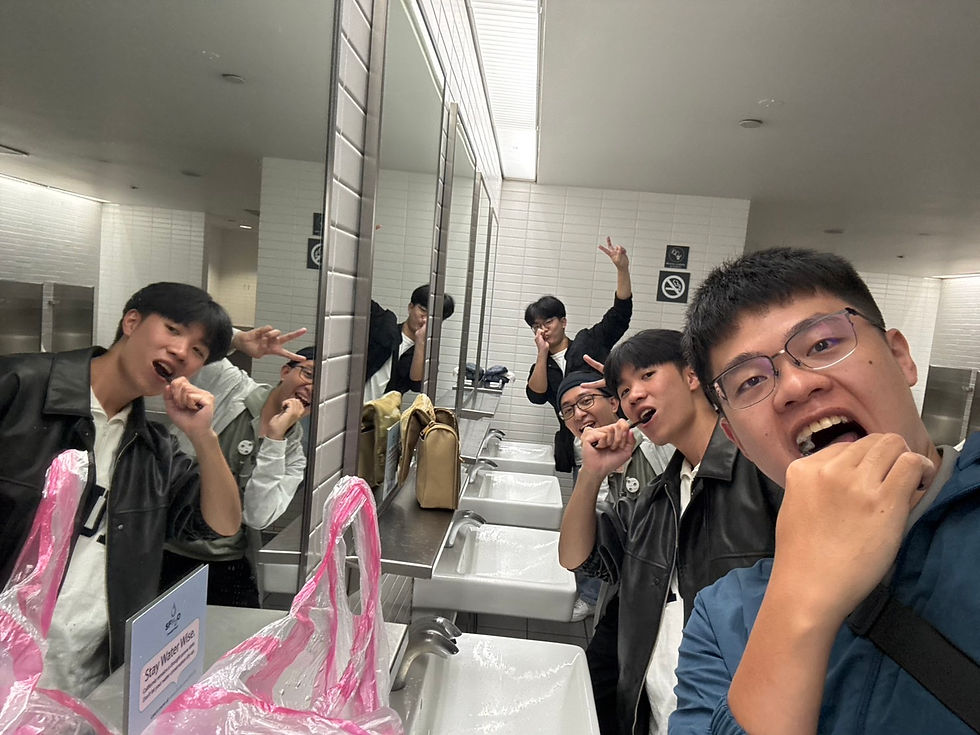
Our day actually began at the airport, where exhaustion really hit us. The boys rushed to the bathroom to brush teeth and wash up, while one of our teammates even did a mini skincare routine. It was a funny but much-needed reminder that sometimes, the smallest habits make you feel human again after long travel.
We then headed straight to Fisherman’s Wharf for the famous clam chowder—something I missed last time. To be honest, it wasn’t exactly what I imagined (let’s just say I might do better in the kitchen myself). The sea lions, however, were a highlight—playful, noisy, and endlessly entertaining.
Along the way, we enjoyed street performers showcasing breakdance flips over five people (yes, five!). Wesley, one of our team, even got invited on stage, making the performance extra memorable.
Another unexpected moment was meeting Taiwanese locals in San Francisco. Though they grew up here and weren’t fluent in Chinese, there was still a strong sense of connection and warmth—it felt good to be welcomed as part of a shared identity.
Later, we visited a Greek-style landmark (Palace of Fine Arts) resembling the Pantheon, where we relaxed on the grass, soaked in the sun, and even came across a wedding photoshoot with brides in elegant dresses.
We wrapped up the day at the supermarket, stocking up for a team-cooked dinner (what’s on the menu tonight? That’s a secret—for now).
A fulfilling start to our overseas journey, with much more to come.
Stanford Energy – Day 2
Today we visited Stanford Energy, where we were warmly welcomed by William, the Head Scientist, and Adrian, a professor and researcher who also has experience founding a startup. Their perspectives gave us a deep dive into both the technical and policy dimensions of energy.
We discussed challenges such as the inefficiency of current grids—where nearly two-thirds of energy is wasted—and the critical link between energy security and political stability. What stood out to me was the idea that solutions should not be framed as nuclear versus solar, but rather nuclear and solar, strengthened by storage and resilience.
Our conversation also touched on Taiwan’s unique situation. William emphasized that true sustainability must account for the hardest-to-decarbonize regions, not just the easiest. He also encouraged us to see constraints as opportunities, much like Israel’s success in water recycling.
Adrian shared valuable insights for entrepreneurs: start with the problem, the product, and the market—not just timing. Too many startups fail by overlooking this. He reminded us that the future belongs not to quantity, but to quality and creativity.
The session closed with a powerful call: “Imagine the unimaginable, and then come up with a plan.” This reminder that desperation can drive innovation left a lasting impression on me.
For me, the biggest takeaway is realizing that Taiwan is not just a participant but also a necessary partner in global energy and AI development. That responsibility—and opportunity—belongs to our generation.
Silicon Valley – Day 3
Our third day brought us deep into the realities of entrepreneurship and the toughest challenges a startup can face.
We first heard from a founder who shared candidly about his journey—from the nerves of pitching at Y Combinator with only a demo video, to the emptiness he felt after his company was acquired and he found himself without purpose at Google. His honesty was striking, reminding us that startup life is as much about resilience as it is about success. His key lesson: your team and your drive matter more than the product itself, and if you have an idea, pursue it—because if you don’t, someone else eventually will.
The discussion then turned toward AI, where we explored both the optimism and the skepticism around the technology. The message was clear: speed is everything—speed of thinking, communication, coding, and decision-making. To stand out, we need to stay on top of change, understand our strengths, and use them to add real value to the world.
Finally, we met someone our own age, a college dropout now working at Cursor. Their rigorous three-stage interview process—including a 600-line coding test, a workshop, and a one-week trial—proved that confidence, usefulness, and a sharp sense of product matter most. It was inspiring to see someone so young already carving out a path with clarity and determination.
What I took away most today is that while hard work and persistence are vital, innovation also requires perspective and balance. Staying stagnant in endless cycles of work can limit creativity, but embracing change and daring to think differently is what drives progress forward.
Berkeley – Day 4
Today we had a closed-door session with Mark Liu, who shared valuable advice about career and responsibility. One point that stayed with me was his emphasis that even as students, we should invest in ourselves while also thinking about how we can contribute to our country and the world—without waiting until we feel “strong enough.” He also reflected that in the past century, Taiwan and China have produced many politicians but no philosophers, a thought-provoking reminder of the importance of long-term vision.
We then had the privilege of hearing from Professor Saul Perlmutter, Nobel laureate in physics. In just ten minutes, he distilled years of research into a clear explanation. His words were inspiring: real discoveries take patience, sometimes more than a decade, and we should take pleasure in proving ourselves wrong—because only then can true progress be made.
Later, the team from Imarena shared their product with us, followed by a tour of Berkeley’s beautiful campus. The atmosphere was vibrant and welcoming, and I was deeply inspired by the energy of the students we met there.
A day filled with wisdom, perspective, and inspiration—one that reminded me of both the patience required in science and the urgency of contributing meaningfully, even as students.
Silicon Valley – Day 5
Today we visited two companies—Cerebras (data centers and chips) in the morning, and Skydio (drones) in the afternoon.
At Cerebras, I came face-to-face with the scale of data centers. To be honest, the facilities themselves looked quite similar to one another, and at first I did not find them particularly special. But what struck me was the business model—Colovore essentially sells electricity, water, and space to companies renting their data center capacity. I had never thought of data centers in this way before, and it gave me a new perspective on infrastructure as a business.
From an engineering perspective, I wasn’t as impressed by the chip demonstration. Having seen comparable AI models like Mistral in action, the performance didn’t feel extraordinary. But the sheer fact that the factory is fully booked out made me realize the overwhelming demand for compute power and the scale of this industry. It also left me with a sense of frustration—there’s so much about the internal structure and mechanisms of data centers that I don’t yet understand, and I want to dig deeper.
The afternoon at Skydio was the highlight of the day. Not only did we get to test their drones firsthand, but I also had the chance to ask detailed technical questions. While flying, I noticed some weaknesses and limitations—almost like doing penetration testing in real time. This gave me confidence in my ability to analyze technology critically and think about improvements. I wish we had more time, since the CEO and CMO were in a rush, but even so, the CEO personally took the time to listen to our presentation and asked us questions. For such a major company, this openness and humility left a strong impression.
One of my biggest reflections from today was watching my non-technical peers’ reactions. Many of them were fascinated by the tangible, “cool” side of technology—seeing the drones fly, watching compute power at work—things that, for me, feel almost ordinary after years of exposure. Their excitement reminded me that technology must communicate on two levels: first, it must truly drive change in the world; second, it must look and feel inspiring enough that even those without a technical background can immediately sense its value. That balance between substance and presentation is crucial, especially for entrepreneurs.
San Francisco – Day 6
Our day began at Castro Street—famous for its history and culture. The very first moment off the bus was chaotic: we encountered an aggressive man mocking Asians, which was unsettling, but also a reminder of the realities in big cities. As our senior introduced the street’s history, I realized how little I had studied beforehand. Even something as familiar as the rainbow flag carries layers of meaning, including why two original colors were removed—details I had never thought about before.
Walking around was much lighter in mood. I loved the charm of the streets, especially the Victorian-style architecture. We browsed small shops filled with fun souvenirs, and I couldn’t resist buying a fridge magnet and a poetry collection from a nearby bookstore. The store had books on medieval magic, LGBTQ+ history, and other rare topics I would never find in Taiwan. Street musicians added to the lively atmosphere, and even the fruit stands felt like scenes pulled straight from American dramas—huge, colorful, and relaxed.
Lunch was pizza—just one slice was enough to fill me up. Saying “keep the change” for the first time was oddly satisfying, even if it was just to avoid taking coins. A kind old man at the pizza place suggested a park nearby, but after walking around for a long while, we never found it and simply enjoyed the street view instead.
In the afternoon, we visited the Museum of Modern Art. Honestly, I was disappointed. Exhibits like broken ventilation pipes, blank canvases, neon tubes, or unsettling robot dolls didn’t resonate with me. I felt much of it lacked the beauty and emotional depth I expect from art. To me, true art—like Greek sculptures, architecture, or classical paintings—should inspire awe through form, craft, and expression, not just provoke abstract questions. Ironically, the museum gift shop turned out to be more enjoyable than the exhibits themselves.
We then toured LinkedIn headquarters, which was an honor and quite an inspiring stop, before heading to Macy’s for some shopping. Afternoon tea was a shared experience with friends, full of laughter and sweet desserts, and our waiter’s enthusiasm made it even more fun. On the walk back, spotting rows of sports cars was an exciting bonus.
A small frustration came at dinner prep time: cooking, washing, and cleanup ended up falling on the boys, while some girls avoided the work. I was conflicted—on one hand, I admire the patience and good temper of the guys, but on the other, I dislike unfair expectations. Still, it was a reminder of how social dynamics play out even in small groups.
By the evening, some classmates experimented with cannabis edibles—thankfully not me. Watching the effects up close was enough to convince me that I made the right choice.
Overall, the day gave me both joyful cultural discoveries and deeper reflections. Compared to some of my peers with literary backgrounds who write in a more poetic style, my way of recording is simpler—I write what I see, what I like, and how I feel. And for me, experiencing this version of American life is already a dream in itself.
San Francisco – Day 7
Today’s itinerary was one of the most anticipated of this trip—not because it was strictly academic or tied to official visits, but because it was about exploring the city with close friends. Sometimes the best memories are made this way.
We started by taking the BART (yellow and orange lines) to Berkeley. With just five of us traveling, I felt a bit tense on the subway, scanning for potential threats, holding nothing but a banana peel as “self-defense.” Along the way, we encountered aggressive street people, including one who mocked Asians and demanded money from us. It was unsettling, but also sobering—I realized how differently we must appear through their eyes, perhaps as privileged visitors who could “save” them.
Back on Berkeley’s campus, I felt a wave of nostalgia. I had been here last year, but this time the visit struck me differently. Seeing the tower, the green spaces, and the energy of the campus reminded me why I want to study here one day. Whether it’s Berkeley or Stanford, these places can feel impossibly far away—but with the support and meeting alumni of the Foundation, I know that if I don’t dare to try, apply, and work hard, then I will never make it. Standing in front of the graduation stoles at the gift shop, I silently promised myself: I’ll come back here as a student, not just a visitor.
For lunch, we enjoyed authentic Mexican food—tacos and Mexican Coke, which were miles better than Chipotle. Afterward, we stopped by the Exploratorium. The tickets were pricey, so we only browsed the gift shop, but even that was impressive. The books, toys, and science-themed items were inspiring in a way I rarely see in Taiwan. I bought a meteorite necklace, complete with details of origin—something genuine and meaningful.
In the afternoon, we met a friend of one of our classmates from Berkeley. She was brilliant, warm, and easy to talk to—exactly the kind of person who makes you feel the value of these connections. Together, we experienced Waymo’s self-driving car. Even though I’ve read about them and seen videos, sitting inside with no driver at the wheel felt surreal. Watching the steering wheel move on its own, guided by sensors, finally helped me understand why non-technical people find technology so magical—it really did feel like stepping into the future.
Later, we stopped by the San Francisco Giants’ gift shop and we made a near-mistake: straying too close to the Tenderloin district. The atmosphere was dangerous—clusters of homeless people, drug use in the open, and tense confrontations on street corners. At one point, it felt like threats surrounded us from three sides. Holding a glass bottle of Mexican Coke tightly, I was prepared to fight if necessary while protecting a classmate walking with me. My heart raced, and for the first time, I truly felt how close danger—and even death—could be. It was a terrifying experience, and I resolved that when I return home, I must train in martial arts and strengthen myself. There cannot be a “next time” where I am unprepared.
From there, the day lightened again—we took the classic San Francisco cable car. It was exhilarating: fast, open-sided, with the freedom to wave at strangers on the street. I even had the chance to chat with a German family in German, which gave me a boost of confidence and motivation to improve my language skills further. At Lombard Street, we took plenty of photos before saying goodbye to our new Berkeley friend.
Our Uber driver back was another highlight—a young man from Nepal, with degrees in mechatronics and an MBA, now studying cybersecurity while driving part-time. His stories of travel, study, and resilience were inspiring. My classmate even spoke to him in Korean, which made me realize I also want to learn another East Asian language and find ways to volunteer globally. I even introduced to him the Foundation, proudly representing our program without being asked.
Dinner was delicious, especially the coconut juice, and though we came back a bit late, everyone was exhausted in the best way. After budgeting, showering, and writing, I listened to some lo-fi music before bed.
It was a full day—filled with friendship, discovery, risk, and reflection. I left with new memories, new inspiration, and a clearer view of where I need to grow.
San Francisco – Day 8
This morning we visited Builders Initiative, an investment group that deeply impressed me. What stood out was their philosophy: they don’t just pursue profit, but focus on making an impact on the world. They invest in startups that create real environmental benefits. If a company’s impact is modest, they prefer to let others invest. But if the impact is large, they will even go the extra mile to gather more investors and make sure the project succeeds.
I admired their mindset of acting as a catalyst—investing first to inspire confidence so that others follow. This spirit of being a pioneer is rare and admirable. A classmate also pointed out an important reality: sustainable investment is costly, and many people only care about profit. A product still needs to be “better, faster, or cheaper” to gain traction. Another classmate shared a sharp reminder: “no money is a form of unsustainability”—without financial returns, even the best projects cannot continue.
One of the team members we met, Andrew, studied at Georgia Tech, worked at NASA on the Perseverance rover’s drill, and even spent time at Tesla. Despite his impressive résumé, he chose to focus on sustainability. Why? Because he saw powerful technologies lying unused in JPL’s warehouses, and he felt Tesla was too focused on business interests. He wanted to dedicate himself to meaningful change. That spirit resonated with me deeply.
In the afternoon, we heard from three alumni who are now outstanding entrepreneurs. They not only introduced their products but also gave us advice. One remark struck me: “The future is when AI trains AI, not humans training AI.” Another was blunt: “If you don’t keep improving, you’ll die.” These words may sound harsh, but they reflect the reality of rapid technological change.
I asked a question on behalf of my classmates: how can we make sure we’re part of the cutting-edge environment right from the start? For example, in Taiwan, GPT technology was adopted months later than in the U.S. The first answer I received was disappointing—basically blaming it on the wrong “social circle,” which felt unhelpful.
But Victor’s answer was far better. He said my question was excellent, because our generation craves speed yet often doesn’t realize when they’re outside the key environment. His advice: expand your circles, join opportunities like this overseas visit, observe and listen more, and—most importantly—develop deep expertise in your own field while integrating AI. Since no one can know everything, being strong in one domain and using AI effectively is the best strategy.
I appreciated his answer, but was also saddened that some classmates didn’t recognize the importance of this question—it wasn’t even for me, since I already stay close to the frontlines of AI. Still, I see this as motivation: maybe I can help build ecosystems, communities, or educational initiatives so that more people can catch up.
Today’s lessons reminded me of something simple but crucial: I must stay fully present during these sessions. If I lose focus, I miss out on insights that could shape my future.
Silicon Valley – Day 9
This morning we visited Matter Venture Partners, a firm that left me with a deep impression. The founder not only shared his investment philosophy but also his own personal story—once a top student, he later turned to entrepreneurship and then venture capital. What struck me most was not just his achievements, but his humility and humor. He made the session engaging while still delivering powerful insights. Some quotes that stayed with me:
• “If you do it right, it’s so hard to be copied.”
• “People and market—that’s all you can get in the beginning.”
• “There is no grand plan, just be passionate, curious, and excited.”
• “Cool technology will not get you anywhere—it’s about business impact.”
• “Great people learn to go further with the best people.”
• “Don’t forget where you come from. Understanding history helps you see how people and technology evolve.”
These words reminded me that technology alone does not define success—it is people, impact, and the ability to turn ideas into lasting value.
We then had the privilege to hear from Tacta Systems. They began with a striking fact: 96% of cars are still assembled by humans. Their mission is to create robots with the sensitivity and dexterity of human hands, enabling a new paradigm in robotics. They design robotic gloves for operators, emphasizing that because the world is built for humans, humanlike robots are better suited to train and integrate. It was a glimpse into how robotics may bridge human skill and automation in the near future.
In the afternoon, the focus shifted to a deeply personal theme: the hidden challenges of immigrant startup founders in Silicon Valley. Two speakers shared their journeys—the struggles, the cultural barriers, and the resilience required. From them, I learned:
• “Only when you are strong enough will others respect you.”
• “Grammatical errors can be a serious issue in official documents.”
• “Read widely—biology, space economy, fish, anything—to make yourself interesting.”
• “If you are curious and interesting, connections will follow.”
• “There is no work-life balance if you love your work—your mission itself sustains you.”
• “Life is a venture. You never know what tomorrow brings.”
• “Learn to be a good speaker, listener, and observer. Watch TED talks, listen to podcasts, study founders’ biographies.”
These lessons emphasized that success is not only technical, but human—built on resilience, curiosity, and relationships.
In the evening, we had a group reflection session. For me, the theme of the entire day—and perhaps this whole journey—was simple yet profound: people matter most. The people around me shape how I think, what I ask, and even what I aspire to. My classmates’ curiosity and energy remind me that learning happens not just from speakers, but from each other.
Personally, I also confronted my own fears: fear of arrogance, fear of not measuring up to peers who go to Harvard, MIT, or Stanford, fear of not achieving something big in ten years. But I realized fear itself can be a driver. It can push me to take action, to be humble yet ambitious, to keep learning and striving.
Memories from this journey will stay with me—not just the scenes or the people, but the lessons and reflections they sparked. In the end, it all comes down to one thing: action. Action to apply what I’ve learned, to build, to create, to lead.
We are future leaders in action, and this trip reminded me that the first step is to dare—to stay curious, to stay bold, and to keep moving forward.
San Francisco/ Taiwan – Day 10
Coming back to school after the trip felt strange. For ten days, we visited incredible places, met inspiring people, woke up early with friends, learned something new every day, and shared meals that all carried meaning. Suddenly, to return felt like being cast from heaven back to earth.
What I realized is this: the most important thing is to keep learning, keep producing, and keep creating meaning. Without that, it’s too easy to slide back into old habits. Transition is never easy, so I remind myself—don’t rush. Give yourself time to transform. Rest a little, read good books, recharge. But don’t stay stagnant for too long.
The hardest part is knowing that some goodbyes may be forever. The best version of one another might only exist in memory, slowly fading with time. We won’t see each other often, and people will change. I can only hope that by the next time we meet, others will see a better version of me.
Maybe in ten years, I can send a letter to everyone from Epoch School 2025, asking us to gather again. By then, some may have built great careers, others may be living freely by the sea. I imagine us smiling at the memory, meeting again at the foundation, or simply looking up at the sky with contentment. Isn’t life full of beauty in these moments?
Yet for now, I feel trapped. I still have one year of school left, plus four months of military service. I want to move faster, to make an impact sooner. What I hate is not the environment itself, but how easily I let it shape me. Sometimes, you have to go against the tide—push through the chaos. If I can’t find meaning in daily lectures, why not use the time to build my own project? Why not dedicate these two years to creating something great, something that surprises even myself? Perhaps a startup, or preparation for one.
I haven’t heard much from my classmates since the trip. In a way, that’s good—it allows us all to focus. What matters is transforming ourselves into people we would barely recognize today. To prove to our best friends, and to ourselves, that we are not just people of words—we can, and we will, make a change in this world.
What a wonderful time to be alive.
These are just something that I had jotted down everyday, and my thoughts of the overall journey will be posted in another blog. Wait for Part II.




Comments